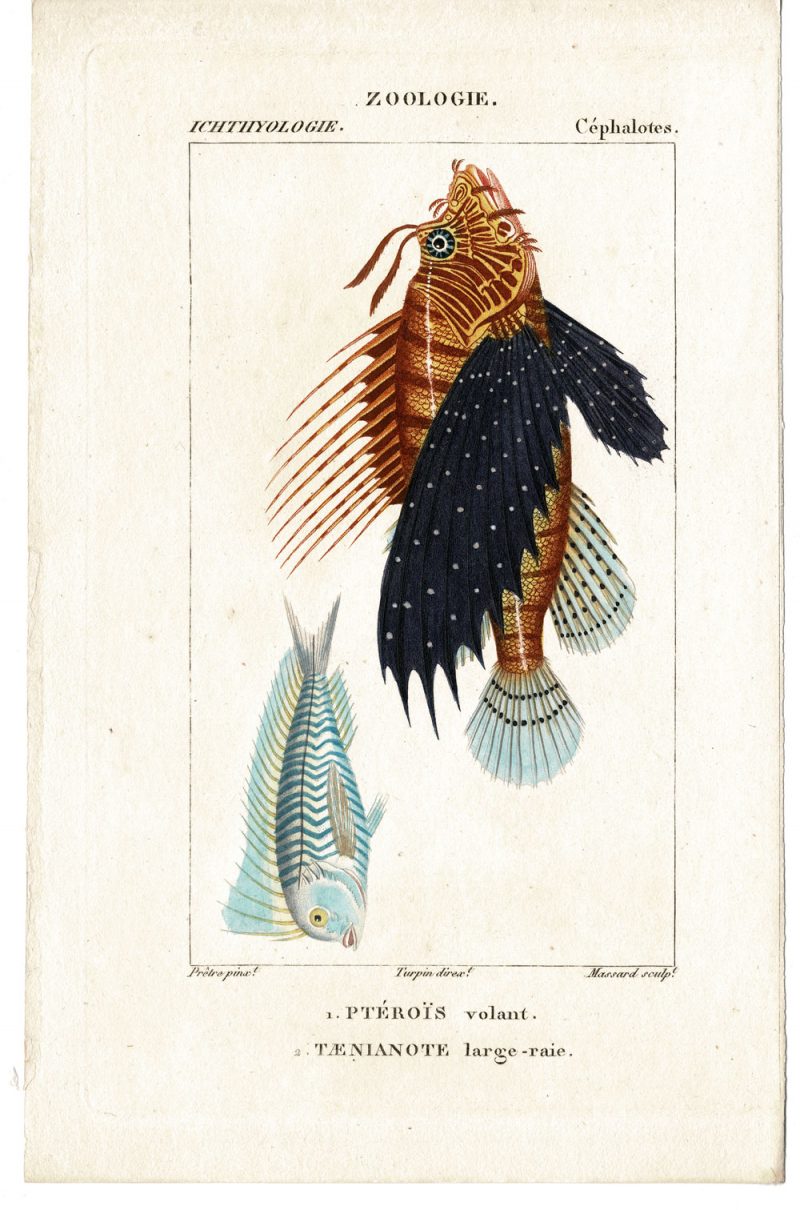
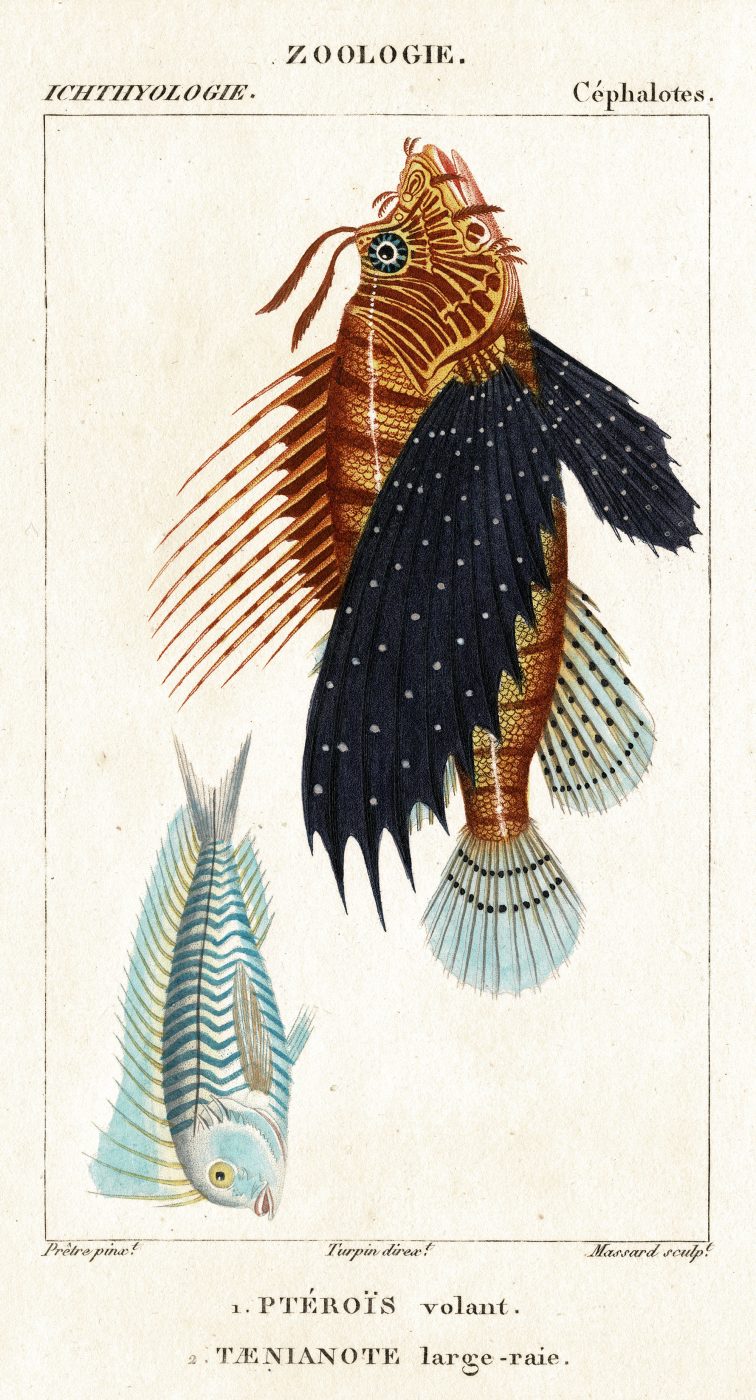
Colorful Tropical Fish – LionFish – Antique Engraving by Turpin
Tropical Fish
From Dictionnaire des Sciences Naturelles by Pierre Jean Francis Turpin, published in France by Levrault, 1816.
Handcolored antique engraving. Turpin was one of the greatest botanical and natural history engravers of his time.
This engraving shows – the Lionfish or Pterois is a genus of venomous marine fish, native to the Indo-Pacific and another tropical fish which is probably incorrectly identified as the Taenianotus or leaf-scorpion fish.
1816
11 March 1775, Vire – 1 May 1840
In-octavo format - Most sheets measure approximately 15 x 23 cm
The Dictionnaire des sciences naturelles was an ambitious multi-volume encyclopedia published by F. G. Levrault between 1816 and 1830, with contributions from many of the leading French naturalists and scientific illustrators of the period. The zoological plates were principally based on drawings by Jean-Gabriel Prêtre, while the celebrated botanical artist Pierre-Jean-François Turpin directed and contributed to the botanical illustrations.
Published in octavo format, the illustrated sheets generally measure approximately 15 × 23 cm.
Jean-Gabriel Prêtre was a Swiss-born natural-history artist celebrated for his precise and elegant representations of animals, birds, shells and other zoological subjects. He first worked as an artist for Empress Joséphine’s celebrated menagerie at Malmaison and was later associated with the Muséum national d’Histoire naturelle in Paris.
Prêtre supplied illustrations for numerous important French natural-history publications of the early nineteenth century. His drawings combined close scientific observation with delicacy of line and composition, making his work valuable both as zoological documentation and as decorative art.
The French botanist and illustrator Pierre-Jean-François Turpin is considered one of the greatest botanical illustrators of his time. He began his study of nature while stationed in Haiti in 1794 as a member of the French army. There he met the botanist Pierre-Antoine Poiteau and began creating botanical field drawings. As an artist, Turpin was largely self-taught.
Turpin subsequently collaborated with many prominent botanists and naturalists, producing illustrations for some of the most important botanical publications of the early nineteenth century. His work is particularly admired for combining scientific precision with exceptional refinement and grace.