Pare-Neige by Jean-Pierre Lermite
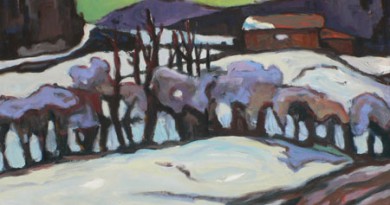
This 1960 lithograph by Jean-Pierre Lermite depicts a pare-neige, a barrier fence designed to hold back, break up, or control snow and prevent dangerous drifting or sudden sliding in winter landscapes. Strong graphic lines sweep horizontally across the composition, intersected by vertical slats and angled supports set against the rolling countryside of the Swiss Jura, with its scattered farm buildings, open fields, and gently rising hills. The repeated linear elements create a rhythmic tension, alternating between density and openness, allowing light to pass through in shifting bands of grey and white. This subtle play of tone evokes winter light in the Jura, where snow flattens the land into broad, pale planes and man-made structures register as sharp, graphic interruptions rather than alpine drama. Though abstracted, Pare-Neige conveys a palpable sense of cold, stillness, and restraint, capturing the quiet geometry of rural Swiss winter infrastructure shaped by wind, snow, and open terrain rather than depicting a literal scene.

Below a mockup illustrating how this work might look once framed (it is sold unframed).

1920 Le Locle-1977
Also known as: Jean-Pierre Schmid
Jean-Pierre Schmid, known as Lermite, was a Swiss painter, printmaker, and graphic artist born in Le Locle in 1920. He trained at the École d’Art in Biel, where he became familiar with early twentieth-century movements including German Expressionism, constructivism, and cubism. In 1946 he settled in La Brévine in a remote house called L’Ermitage, a name that eventually became his artistic pseudonym Lermite (derived from l’ermite, “the hermit”).
While his early work encompassed landscapes, figurative pieces, and expressionist themes, over time he shifted toward geometric and abstract forms, integrating architectural and natural motifs into his prints and paintings. In the late 1950s he embraced lithography, working extensively in grey and black tonal ranges that reflect his interest in structure and spatial rhythm. His art remained deeply rooted in the Jura region of western Switzerland, where rolling hills, rural forms, and winter light exerted a profound influence on his visual sensibility.
Lermite’s work continued to evolve through the 1960s and 1970s, and his contributions were recognized with regional exhibitions and awards. He died in 1977, and a foundation in his name now preserves and promotes his artistic legacy, particularly his explorations of landscape, form, and light.

Condition: Light even age toning. Note that the full sheet has creasing and damage on the outer edges of the sheet. This would easily be covered once matted as illustrated in the mock-up above.