
Les Merveilles de la Mer: Les Coquillages – Paul Valéry and Paul-André Robert, 1936
A beautifully illustrated French volume devoted to seashells, published by Librairie Plon, Paris, in 1936.
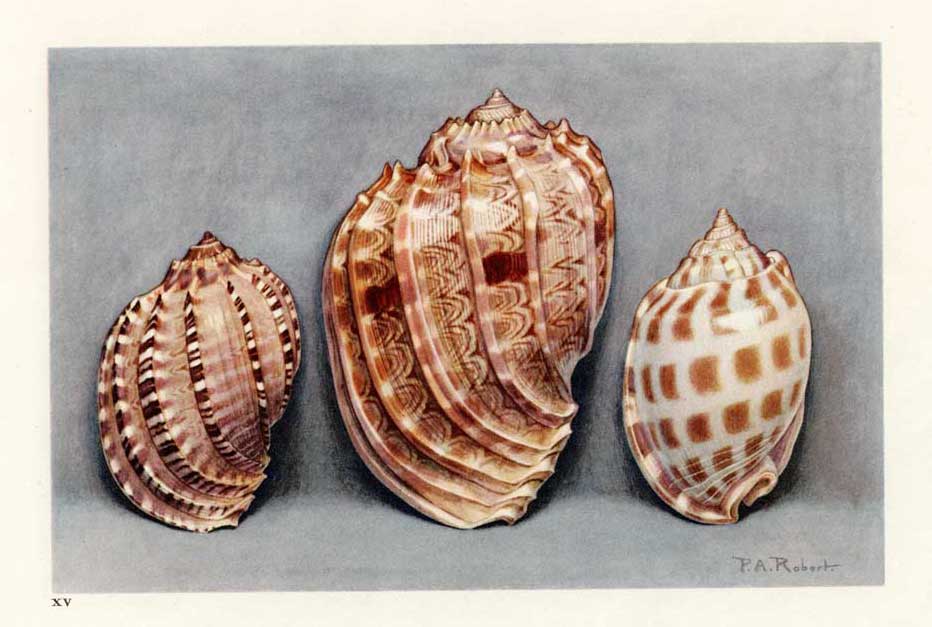
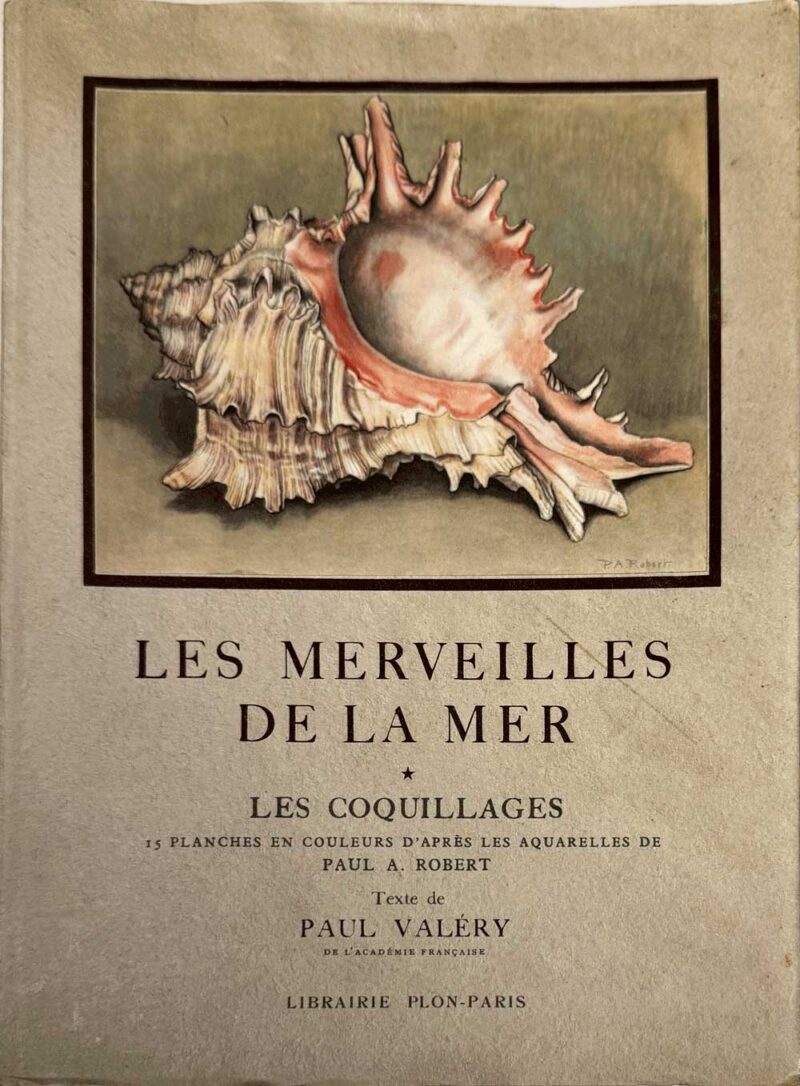
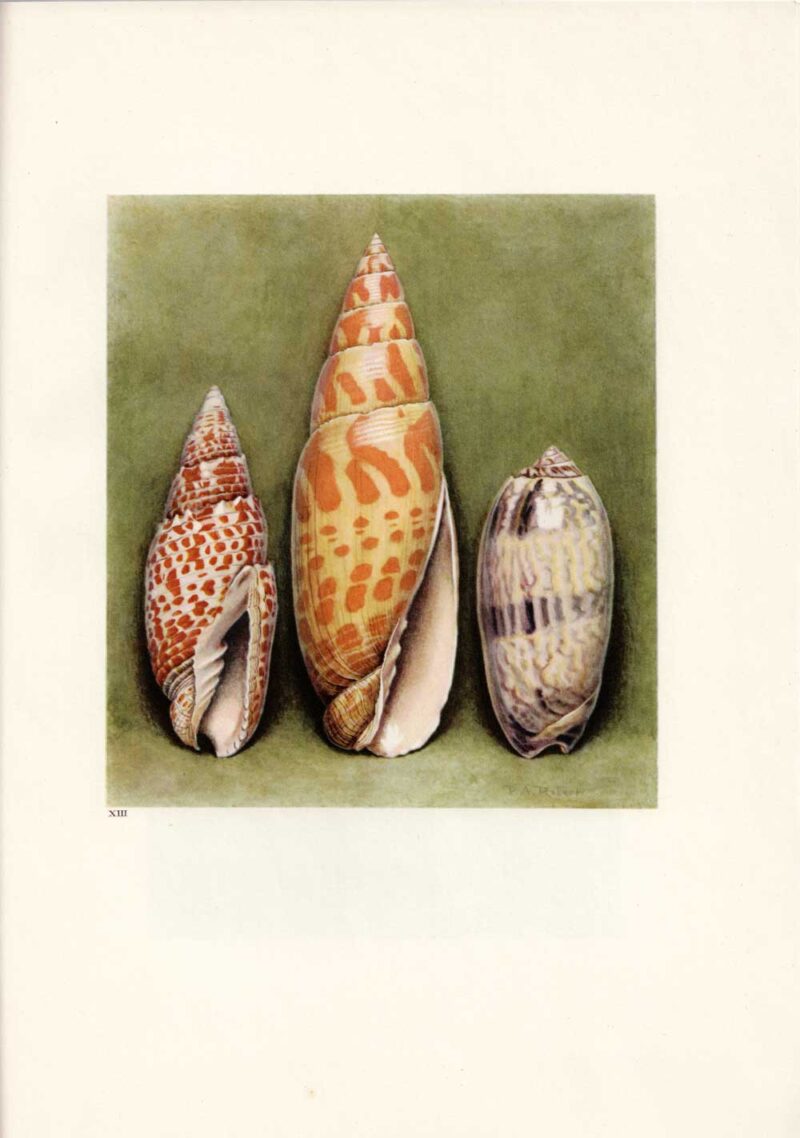
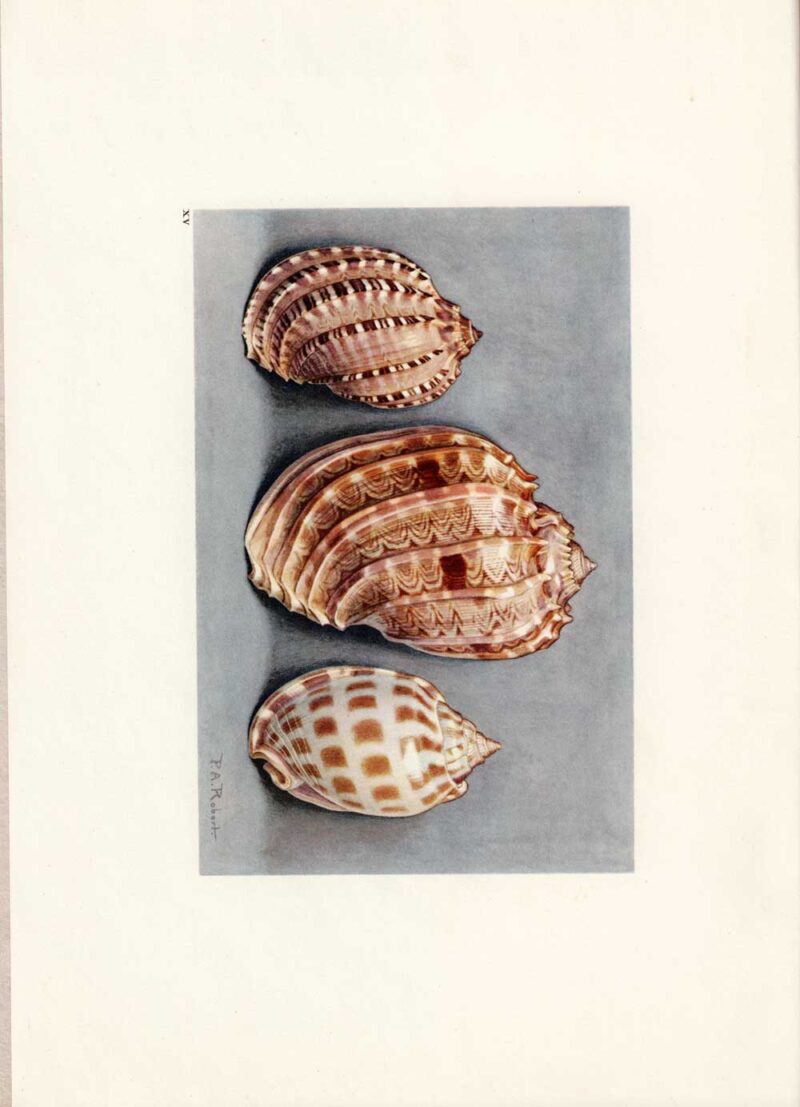
Les Merveilles de la Mer: Les Coquillages combines a text by the celebrated French writer and poet Paul Valéry with 15 full-page colour plates after watercolours by the Swiss naturalist and artist Paul-André Robert (1901–1977). Robert’s carefully observed illustrations present an engaging variety of shells, combining scientific precision with a refined decorative quality.
The volume contains the first edition of Valéry’s essay L’Homme et la coquille, a philosophical consideration of the extraordinary forms and structures created by molluscs. The essay was subsequently revised and published in other forms.
Issued in Plon’s “Iris” collection, the book is bound in its original cream-coloured folding paper cover, with a large colour illustration by Robert. All 15 colour plates are present.
Publication details
Paul Valéry, Les Merveilles de la Mer: Les Coquillages
15 colour plates after watercolours by Paul-André Robert
Paris: Librairie Plon, 1936
Original edition
16 pages of text followed by 15 colour plates
Text in French
Condition
Complete with all 15 colour plates. The original illustrated cover shows light age-related toning and minor handling marks, consistent with its age. The colour plates are very well preserved. The first several text pages of the book have foxing, which is most distinct on the title page, and lighter on the following text pages.
November 10, 1901, Ried, Biel/Bienne - August 20, 1977, Orvin
Paul-André Robert (1901–1977) was a Swiss natural historian, painter, and illustrator, belonging to the renowned Robert family of artists from Biel/Bienne. Following in the footsteps of their father, Paul Robert and grandfather Aurèle Robert, Paul-André Robert and his brothers Philippe Robert and Theophile Robert all became artists. Their great uncle Leopold Robert was also a well known Swiss painter
Paul-Andre became known for his finely observed depictions of plants and insects, with a special focus on butterflies. His works, which combine scientific precision with artistic refinement, are highly regarded in both natural history circles and the art world. He illustrated multiple works on birds, mushrooms and insects including Les insectes, 1936-37, Les libellules, 1958, and Flore et Végétation des Alpes 1956-59.
Today, Paul-André Robert is celebrated as one of Switzerland’s foremost natural history painters of the 20th century.
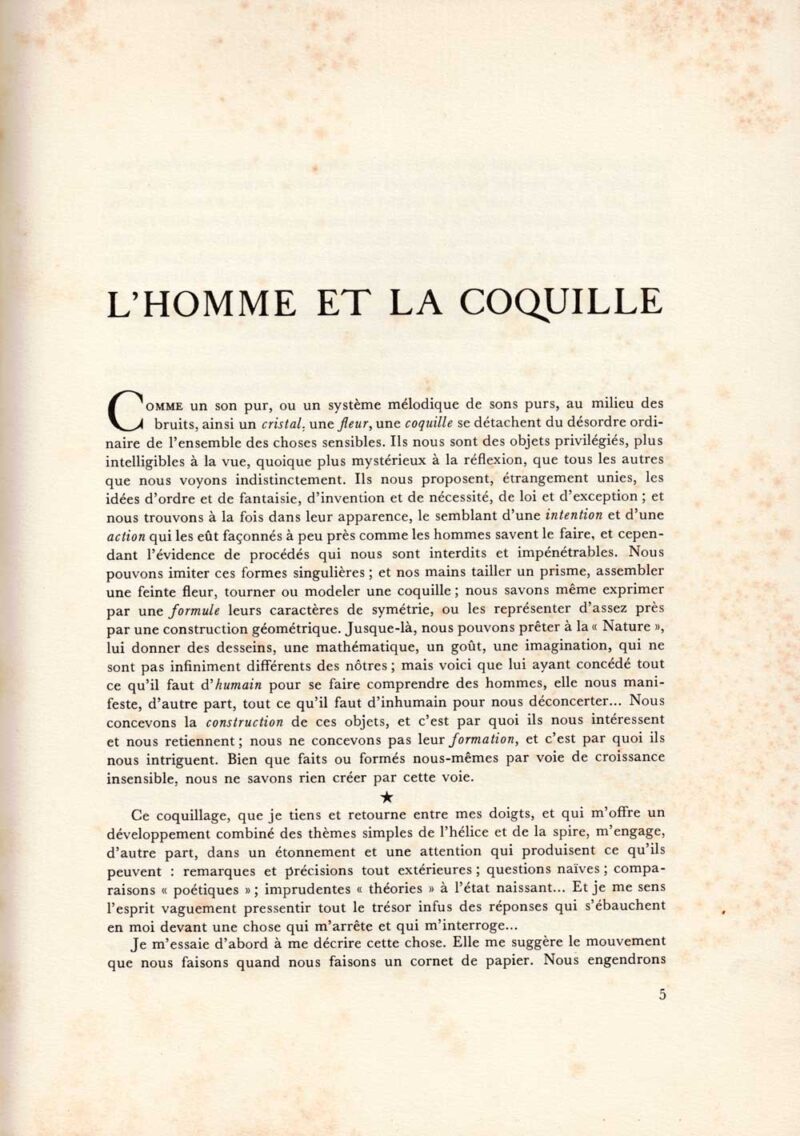
Opening lines of the text in the book by Paul Valéry, original French followed by English translation.
L’HOMME ET LA COQUILLE
Comme un son pur, ou un système mélodique de sons purs, au milieu des bruits, ainsi un cristal, une fleur, une coquille se détachent du désordre ordinaire de l’ensemble des choses sensibles. Ils nous sont des objets privilégiés, plus intelligibles à la vue, quoique plus mystérieux à la réflexion, que tous les autres que nous voyons indistinctement. Ils nous proposent, étrangement unies, les idées d’ordre et de fantaisie, d’invention et de nécessité, de loi et d’exception ; et nous trouvons à la fois dans leur apparence, le semblant d’une intention et d’une action qui les eût façonnés à peu près comme les hommes savent le faire, et cependant l’évidence de procédés qui nous sont interdits et impénétrables. Nous pouvons imiter ces formes singulières ; et nos mains tailler un prisme, assembler une feinte fleur, tourner ou modeler une coquille ; nous savons même exprimer par une formule leurs caractères de symétrie, ou les représenter d’assez près par une construction géométrique. Jusque-là, nous pouvons prêter à la « Nature », lui donner des desseins, une mathématique, un goût, une imagination, qui ne sont pas infiniment différents des nôtres ; mais voici que lui ayant concédé tout ce qu’il faut d’humain pour se faire comprendre des hommes, elle nous manifeste, d’autre part, tout ce qu’il faut d’inhumain pour nous déconcerter… Nous concevons la construction de ces objets, et c’est par quoi ils nous intéressent et nous retiennent ; nous ne concevons pas leur formation, et c’est par quoi ils nous intriguent. Bien que faits ou formés nous-mêmes par voie de croissance insensible, nous ne savons rien créer par cette voie.
English translation
MAN AND THE SEASHELL
Like a pure sound, or a melodic sequence of pure sounds amid noise, so a crystal, a flower or a seashell stands out from the ordinary disorder of the world of sensible things. To us, these are privileged objects: more readily comprehensible to the eye, although more mysterious to reflection, than all the others we see indistinctly. They present us with ideas strangely united: order and fancy, invention and necessity, law and exception. In their appearance, we find both the suggestion of an intention and an action that might have fashioned them rather as human beings know how to do, and yet the evidence of processes that are inaccessible and impenetrable to us.
We can imitate these singular forms: our hands can cut a prism, assemble an artificial flower, or turn or model a shell. We can even express their symmetrical characteristics in a formula, or represent them fairly closely through a geometrical construction. Up to this point, we can attribute to “Nature”—we can endow her with—designs, mathematics, taste and imagination not infinitely different from our own. Yet, having granted her everything human that is required to make herself understood by human beings, she reveals to us, on the other hand, everything inhuman required to disconcert us…
We can conceive of the construction of these objects, and that is why they interest and hold our attention; we cannot conceive of their formation, and that is why they intrigue us. Although we ourselves were made or formed through a process of imperceptible growth, we know how to create nothing by that means.