
Conrad Meyer – The Zürich Mordnacht of 1350 – Antique Swiss Etching, 1676
Conrad Meyer – Sic impia turba peribit: The Zürich Mordnacht of 1350
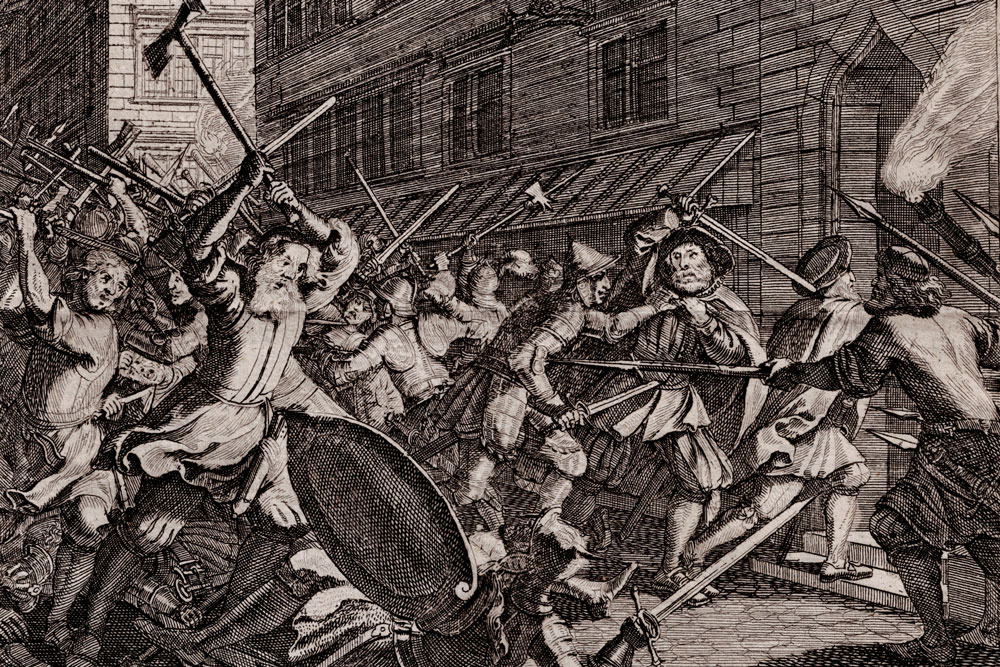
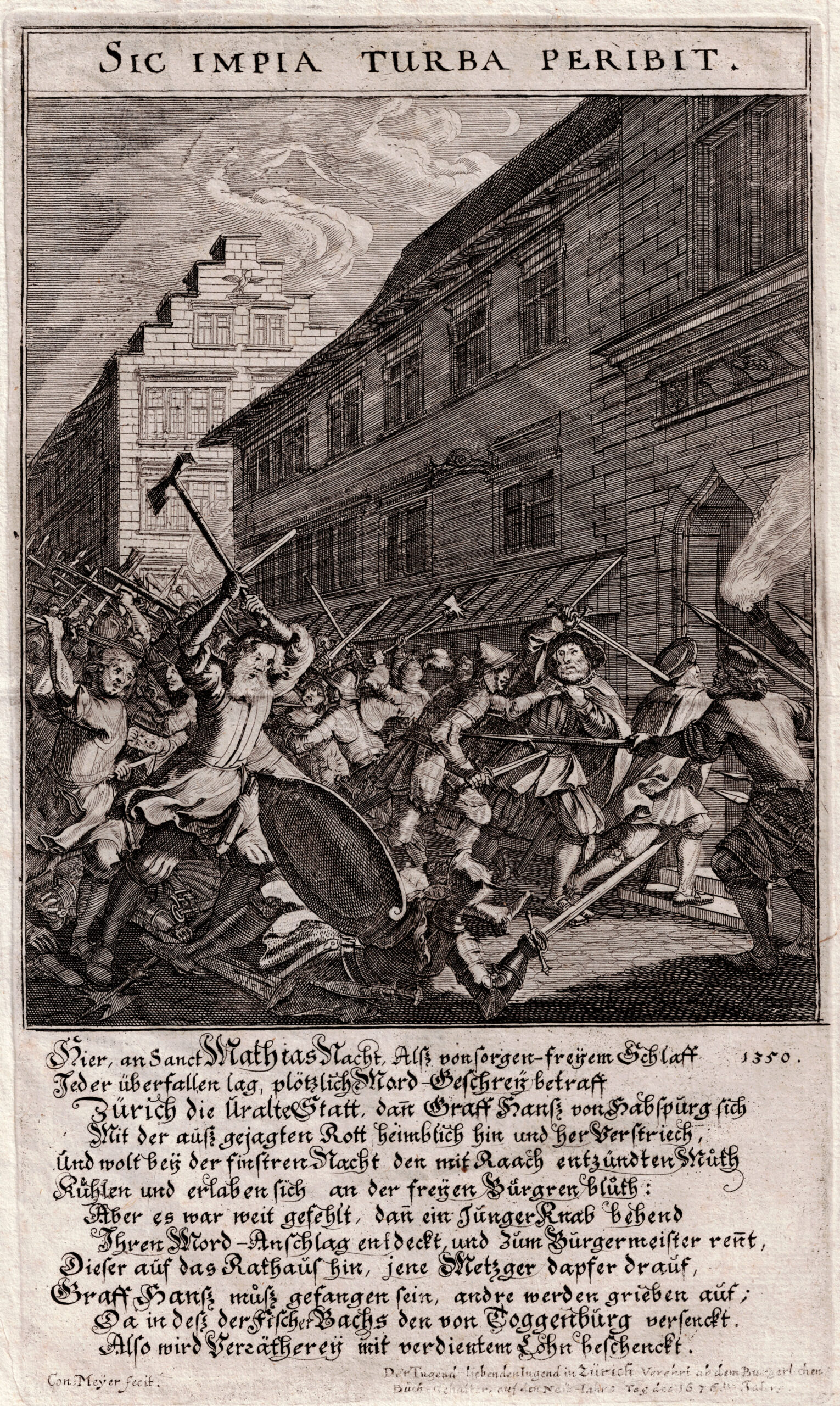
An original 17th-century etching by the Zürich artist Conrad Meyer, depicting the violent street fighting of the celebrated Zürcher Mordnacht of 23–24 February 1350. Armed citizens battle the supporters of the exiled Zürich councillors, while the banner of the Butchers’ Guild—bearing its emblem of a ram—is visible above the crowd.
The conflict followed the political upheaval of 1336, when Rudolf Brun replaced Zürich’s former council with a new constitution in which the city’s guilds played a formal political role. Brun became Zürich’s first mayor and held the office for life. On the night of 23 February 1350, his exiled opponents and their allies attempted to regain control of the city. The plot failed, and Count Johann II of Habsburg-Laufenburg, one of its principal supporters, was captured and imprisoned.
The image follows Zürich’s traditional account of the event. According to this version, a young boy discovered the plot and warned the mayor, while members of the Butchers’ Guild distinguished themselves in the ensuing fighting. Another episode, mentioned in the engraved verse, concerns the fisherman Bachs, who is said to have overturned his boat in the Limmat and drowned a Count of Toggenburg and his companions after overhearing their plan to kill him.
The Latin inscription above the image, “Sic impia turba peribit,” translates as “Thus shall the wicked mob perish.” Beneath the scene is a twelve-line German verse recounting the attack, the warning given to the mayor and the defeat of the conspirators.
The plate is signed “Con. Meyer fecit” and was published in Zürich in 1676 by the Bürgerbibliothek as its annual New Year’s sheet. The Zentralbibliothek Zürich records the work as Neujahrsblatt 1676 and lists it in Hollstein’s catalogue of German prints as no. 231. Zentralbibliothek Zürich catalogue record
Conrad Meyer (1618–1689) was a prominent Zürich painter, draughtsman and printmaker and a member of an important family of Swiss artists. He produced portraits, religious and allegorical subjects, city views and historical scenes and worked with the publishing enterprise of Matthäus Merian. Meyer was closely associated with Zürich’s long-running series of illustrated New Year’s sheets.
Dimensions: Platemark: 15.5 x 26.5 Sheet: 36 X 27 cm
Condition: Nice handlaid chainlinked paper (see photo detail) Very good condition inside plate mark. Light smudging of text. Nice clear lines and strong imprint in illustration. There is some staining in the margins (see photo below). Some tape has been applied to the back outer edges
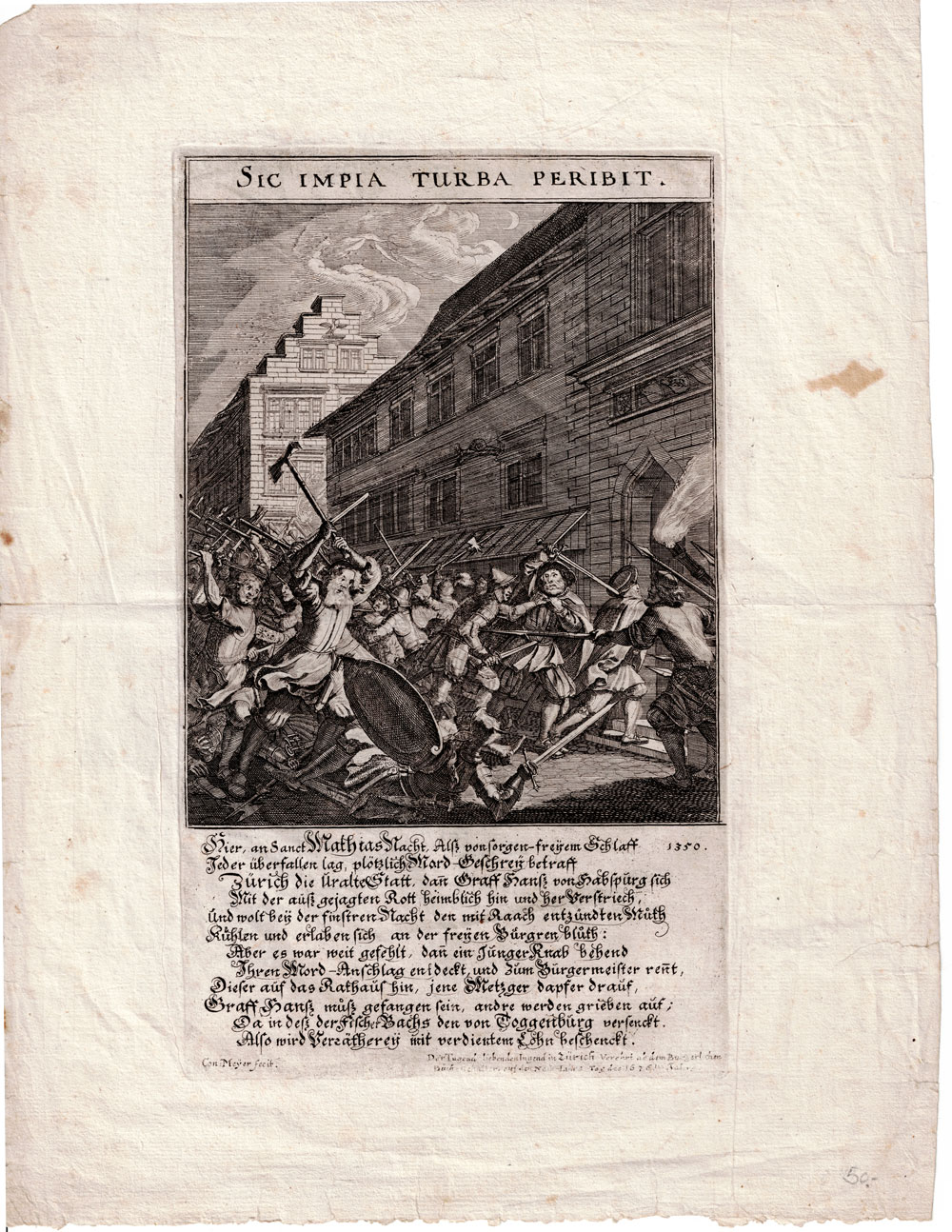
German text reads:
Hier, an Sanct Mathias Nacht, Alß von sorgen-freyem Schlaff, 1350.
Jeder überfallen lag, plötzlich Mord-Geschrey betraff
Zürich die Uralte Statt, dan Graff Hans von Habsburg sich
Mit der auß gejagten Rott heimlich hin und her Verstriech,
Und wolt bey der finstren Nacht den mit Raach entzündten Muht
Kühlen und erlaben sich an der freyen Bürgern Bluht:
Aber es war weit gefehlt, dan ein Junger Knab behend
Ihren Mord-Anschlag entdeckt, und zum Burgermeister rennt,
Dieser auf das Rathaus hin, jene Metzger dapfer drauf,
Graff Hans muß gefangen sein, andre werden grieben auf;
Da in deß der frische Bachs den von Toggenburg verse[n]ckt.
Also wird Verrätherey mit verdientem Lohn beschenckt.
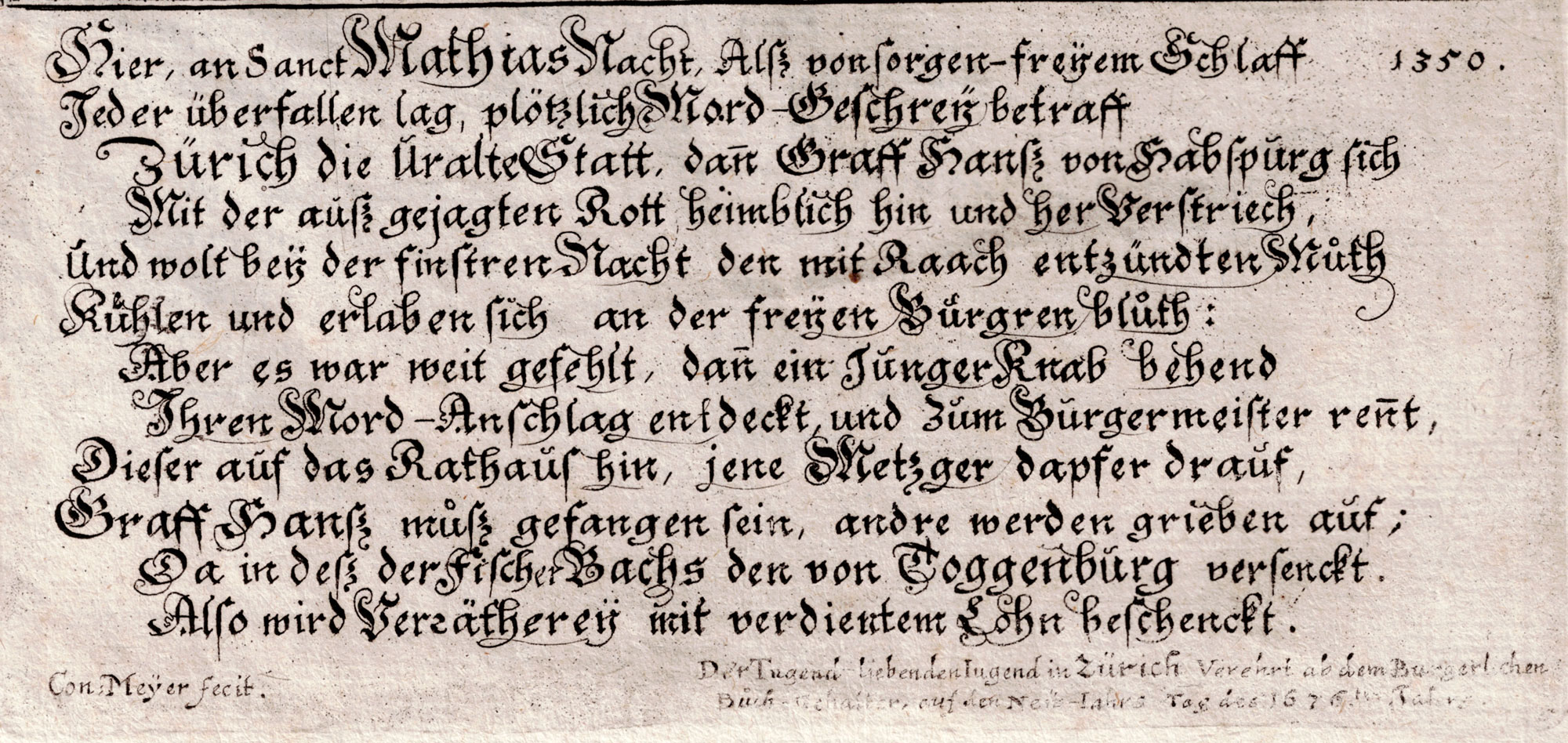
English translation of text:
Here, on Saint Matthias’s night, while everyone lay overtaken by carefree sleep,
a sudden cry of murder struck Zürich, the ancient city.
Count Hans of Habsburg, together with the expelled faction,
had slipped secretly to and fro through the city.
Under cover of the dark night, he hoped to cool his rage, inflamed by vengeance,
and refresh himself with the blood of the free citizens.
But he was greatly mistaken, for an alert young boy
discovered their murderous plot and ran to the mayor.
The mayor hurried to the town hall, while the butchers bravely attacked.
Count Hans was taken prisoner, and others were cut down;
meanwhile, the spirited Bachs sank the man of Toggenburg.
Thus treachery is rewarded with the punishment it deserves.