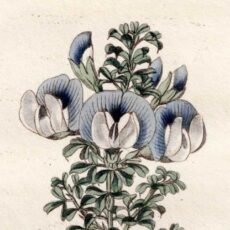
Curtis’s Botanical Magazine
 Curtis’s Botanical Magazine is the longest continuously published botanical periodical in the world, first issued in 1787 and still produced today. Founded by the English botanist and apothecary William Curtis, the magazine was created to make newly discovered and cultivated plants accessible to gardeners, collectors, and scientific readers alike. Curtis believed that clear botanical description should be accompanied by accurate and beautiful illustration, and from the beginning each issue featured finely engraved, carefully hand colored plates.
Curtis had previously worked at Royal Botanic Gardens, Kew, and although the magazine was initially an independent venture, it quickly became closely associated with Kew. As Britain’s global botanical networks expanded through exploration and empire, many newly introduced species passed through Kew’s collections before appearing in the pages of the magazine. Over time, the publication became an essential record of horticultural discovery, documenting plants from South Africa, the Americas, Asia, Australia, and beyond.
After Curtis’s death in 1799, the magazine continued under a succession of distinguished botanical editors, most notably William Jackson Hooker and later his son Joseph Dalton Hooker, both directors of Kew. The publication’s scientific credibility grew alongside its artistic excellence.
A remarkable roster of artists contributed to the magazine over more than two centuries. Among the most celebrated were:
-
Sydenham Edwards, one of the earliest and most prolific illustrators of the series
-
James Sowerby
-
Walter Hood Fitch, whose energetic style defined much of the mid 19th century output
-
Matilda Smith, the first official botanical artist at Kew and one of the most significant female scientific illustrators of her era
-
Lilias Marianne Medland
Each artist combined scientific precision with aesthetic sensitivity, resulting in plates that are valued today not only as botanical documents but also as works of art.
Early issues were produced as copper engravings with hand coloring, while later periods incorporated lithography and other advances in printing technology. Despite changes in technique, the defining qualities remained consistent: clarity of structure, faithful coloration, and a focus on individual species presented against a plain background to highlight diagnostic features.
Today, prints from Curtis’s Botanical Magazine are prized by collectors, gardeners, and interior designers alike. They represent over two centuries of horticultural history and stand as a testament to the enduring collaboration between science and art.