
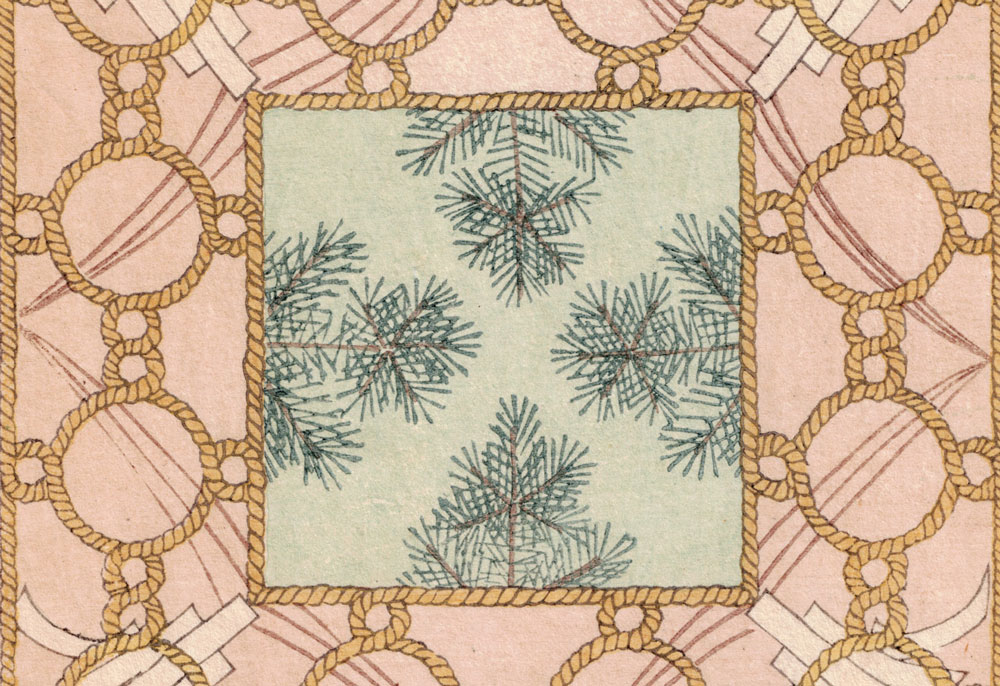
Japanese Art Nouveau Inspired Design Meiji Period Woodblock
Japanese Woodblock Design Print – Matsu-no-uchi (Within the Pines) – Meiji Period
In Japan, the Meiji era (1868-1912) was a period of dramatic political, social, and cultural change, during which a long-closed, reclusive Asian country rich in tradition and artistic expression in many forms opened up to the world, fostering new commercial and diplomatic relationships. Meiji marked the start of Japan’s deep engagement with Europe, the United States, and other parts of the West, as well as the start of its fast-accelerating process of modernization.
This print’s title appears to read “Matsu no uchi” (“Within the Pines”), a phrase that may also be associated with the traditional Japanese New Year period, when pine decorations are displayed to welcome the arrival of protective spirits. “Matsu” means “pine.” In Japanese culture, the pine tree symbolizes longevity and good fortune.
Our thanks to Tokyo-based art historian and critic Edward M. Gómez, a specialist in Japanese art, for his assistance and for adding the following observation: “This skillfully produced print, with its evocation of everything from kimono fabric to traditional, hand-printed, Japanese wrapping paper, serves as a fine souvenir of a time when Japanese designers and artisans were beginning to respond imaginatively to Japan’s fast-developing interchange of styles and aesthetic ideas with the West.”
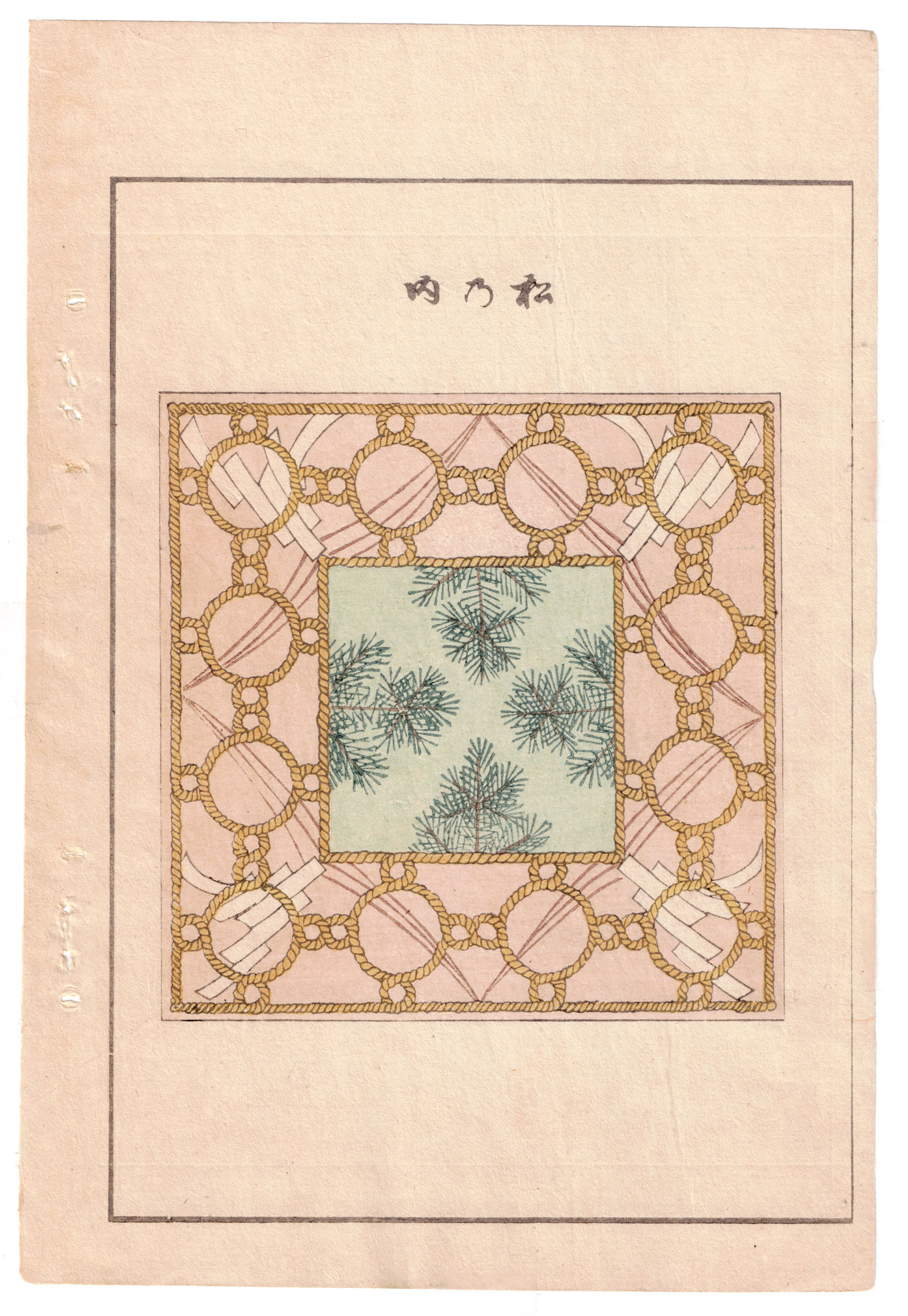
We believe this sheet comes from Shin Bijutsukai (New Art World), an illustrated Japanese design sourcebook intended for artists, craftsmen and designers published in Kyoto in the early twentieth century. An annotation which came with the print bears an early collector’s pencil annotation identifying it as “Bijutsu Kai” and referencing Yamada Saburo. These publications provided an extensive visual vocabulary of ornamental motifs for use in textiles, ceramics, lacquerware, architecture, book illustration and the decorative arts, and became essential working references for Japanese artists and designers.
By the turn of the twentieth century, these Japanese design publications had also become highly prized in Europe, where they played a significant role in shaping the emerging Art Nouveau and Jugendstil movements.
Collectors familiar with the Swiss Style Sapin movement centred on La Chaux-de-Fonds will immediately recognise a similar celebration of stylised evergreen forms and decorative abstraction. While developed independently, both traditions belong to the same international artistic dialogue that transformed design around 1900 and helped establish a new visual language inspired by nature.