
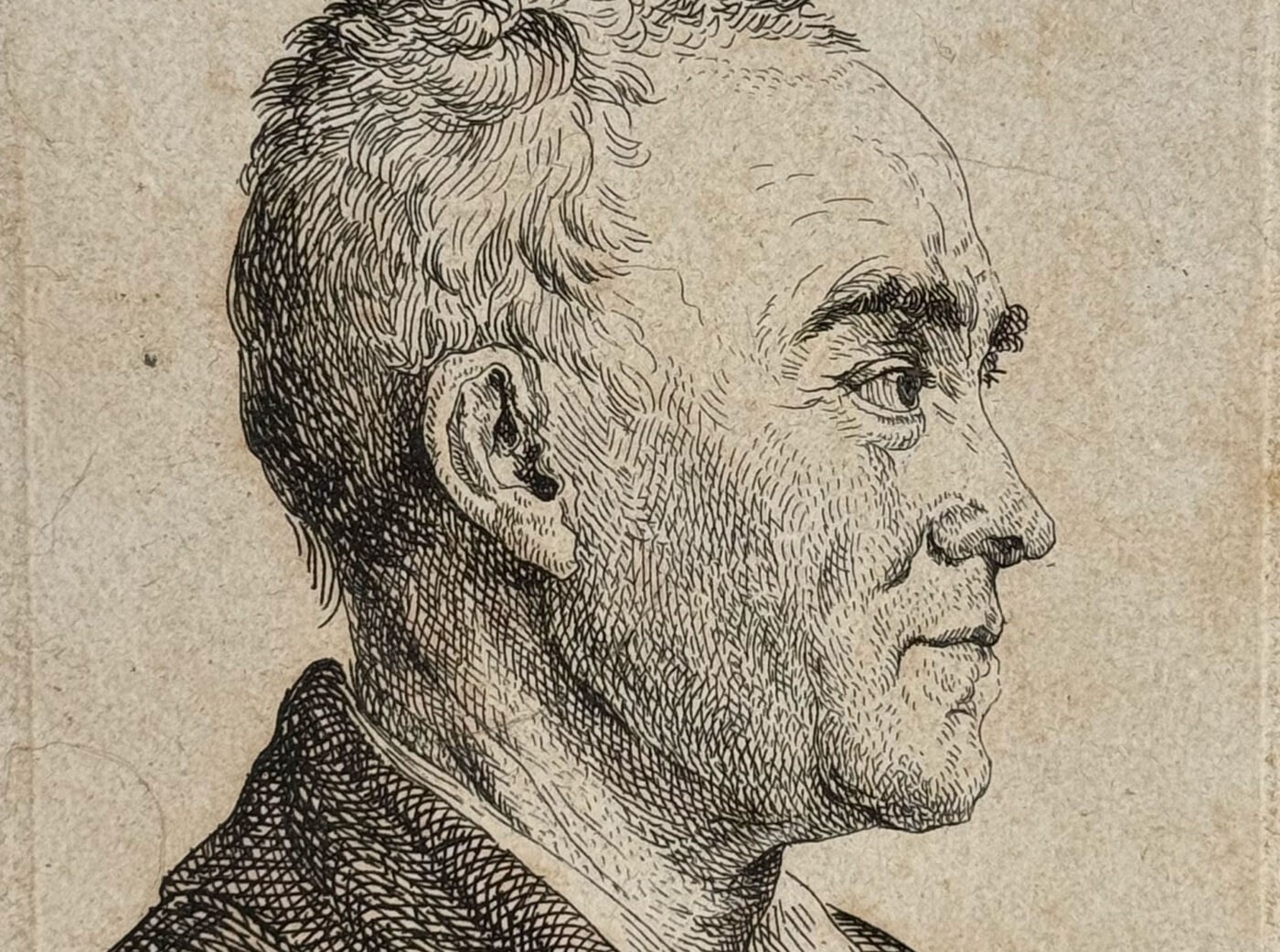
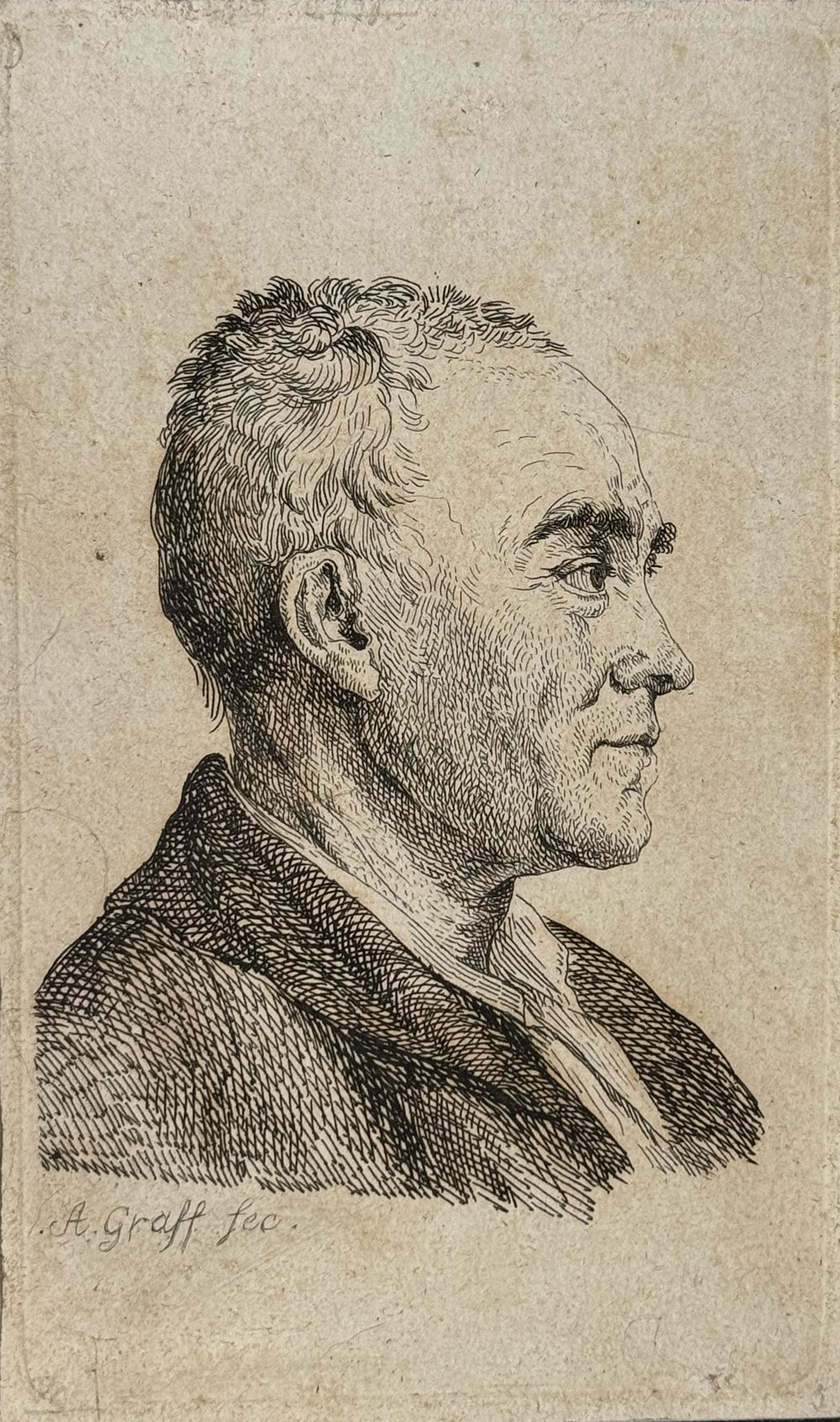
Anton Graff – Portrait of Johann Georg Sulzer
Anton Graff (1736–1813)
Portrait of Johann Georg Sulzer, 1774
Etching on laid paper
Signed in the plate lower left: A. Graff fec.
Plate approximately 15.4 × 9 cm –
Condition: Light age discoloration and markings and cut to the edge of the platemark as shown.
This finely observed profile portrait depicts the Swiss philosopher and art theorist Johann Georg Sulzer. Graff presents his sitter without distracting attributes or an elaborate setting, concentrating entirely upon the distinctive profile, alert expression and thoughtful character of the man. Delicate, closely worked lines model the face, while denser cross-hatching defines the hair, coat and shadowed areas. The restrained composition and economy of means give the portrait an immediacy that recalls a drawing made from life.
The inscription A. Graff fec.—“Anton Graff made this”—identifies the work as Graff’s own etching rather than a reproductive engraving made by another printmaker after one of his paintings. The portrait is recorded in Ekhart Berckenhagen’s catalogue raisonné of Graff’s work as number 1348. An impression in the National Gallery of Art, Washington, is catalogued as the second of three states and has a plate size of 15.4 × 9 cm. National Gallery of Art
Anton Graff
Anton Graff was born in Winterthur in 1736 and became the foremost portraitist of the German Enlightenment. Appointed court painter to the Elector of Saxony and a member of the Dresden Academy in 1766, he portrayed many of the era’s leading writers, philosophers, musicians, aristocrats and public figures. His sitters included Friedrich Schiller, Gotthold Ephraim Lessing, Moses Mendelssohn, Johann Gottfried Herder and Frederick the Great. Graff was admired not merely for recording physical likeness, but for conveying intelligence, temperament and psychological presence. Sulzer himself praised Graff’s ability to look into the depths of a sitter’s soul—an observation particularly appropriate to this intimate portrait. Staatliche Museen zu Berlin
Johann Georg Sulzer
Johann Georg Sulzer was born in Winterthur, Switzerland in 1720 and became an influential philosopher, aesthetician, mathematician and educational reformer in Enlightenment Berlin. He taught mathematics and philosophy, joined the Berlin Academy of Sciences in 1750 and later directed its philosophical section. His principal work, the encyclopaedic Allgemeine Theorie der schönen Künste, published in 1771–74, examined the principles of literature, music, theatre, architecture and the visual arts. Sulzer believed that art should cultivate both feeling and moral understanding, making him an important contributor to eighteenth-century debates about aesthetics and education. He was also personally connected to the artist: Graff married Sulzer’s daughter Augusta in 1771, making Sulzer his father-in-law. The resulting portrait therefore possesses a degree of personal intimacy as well as considerable intellectual and historical interest.