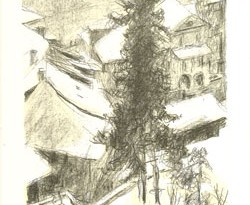
Farm buildings in the Snow by David Albert Häubi
This limited edition lithograph, titled Verschneiter Hof im Gau (Snowy Farm Buildings in the Countryside), was created in 1945 by the Swiss artist and art educator David Albert Häubi (1891, Bern – 1963, Ligerz). Signed “A. Häubi,” dated 1945, and numbered 71/180, the work depicts a snow-covered farm courtyard rendered with architectural clarity and a strong sense of winter stillness.
Häubi was trained in Munich from 1910 to 1913, where he received a solid academic foundation in drawing and graphic techniques. After the Second World War he continued his studies at the Gewerbeschule in Basel, and from 1928 onward worked as a drawing instructor in Olten. Alongside his teaching career, he produced drawings and lithographs that focus on rural architecture, farm buildings, and the countryside, subjects approached with restraint, accuracy, and a quiet observational tone. Lithography suited his interest in tonal nuance and seasonal atmosphere, particularly in winter scenes where buildings themselves convey human presence.
The image shows a compact grouping of agricultural buildings arranged around an enclosed courtyard, a configuration typical of working farmsteads designed for shelter and efficiency. Steeply pitched roofs and solid masonry walls reflect practical responses to snow and cold, while the inward-facing layout creates a protected working space. The term Gau is used here in its older, non-specific sense to mean the countryside rather than a named place, reinforcing the representative nature of the scene. Häubi presents not a particular farm but a familiar rural ensemble, recognizable across much of the Swiss countryside.
Snow blankets the buildings and ground, softening outlines and muting contrasts. No figures appear, yet the courtyard feels inhabited, suggesting activity temporarily paused by winter. Dated 1945, the work was created at a moment of transition at the end of the Second World War. Whether drawn during the final months of the conflict or later that year cannot be determined, but its calm focus on shelter, endurance, and traditional rural life resonates strongly with its historical moment, offering a quiet image of continuity at a time of widespread change.